

Theory
Science & proportion
Dürer bound art to measurement: perspective, geometry and the proportion of the human body, set down in print for others to use.
01
Method
Where drawing becomes proof
For Dürer the line was not only beauty but knowledge. He studied perspective in Italy, built instruments to measure space, and devoted his last years to treatises that made the artist's craft teachable, reproducible and exact.
Perspective
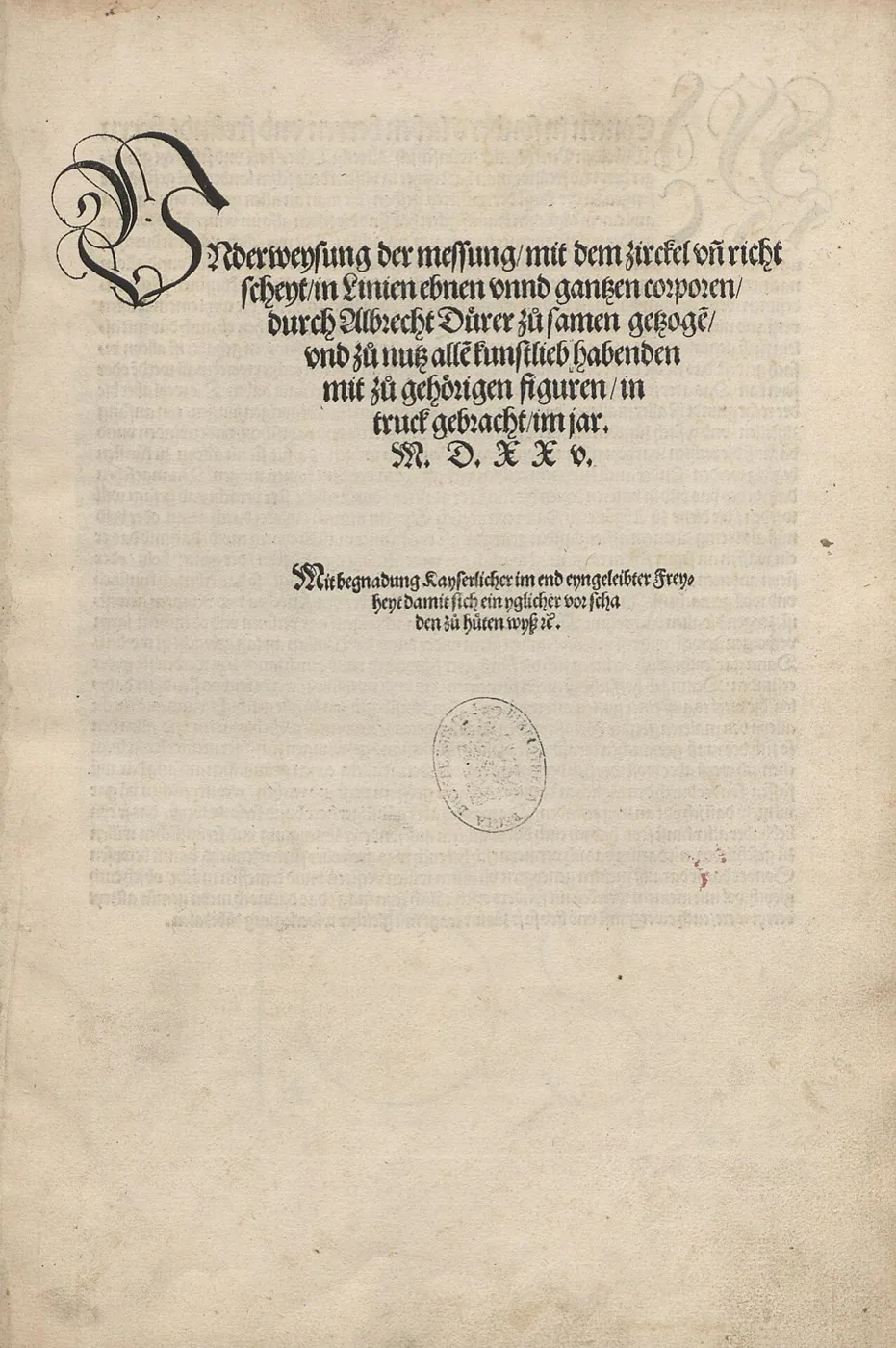
Depth built by projection. Dürer’s drawing frames and the Underweysung let any craftsman set a ruled, repeatable space on the page.
Geometry
From point and line to conic sections, spirals and letterforms — a working geometry for painters, masons and the printed type itself.
Proportion
Bodies generated by ratio, not copied. The Four Books measure and vary the human figure as a system of rules rather than a single ideal.
02
Writings
The theoretical works
- 1525
Underweysung der Messung
A manual of geometry and perspective for painters and craftsmen — the first of its kind in German.
- 1527
Fortification
A treatise on the defence of cities, applying measure to architecture and war.
- 1528
Four Books on Human Proportion
A systematic geometry of the human body, published in the year of his death.